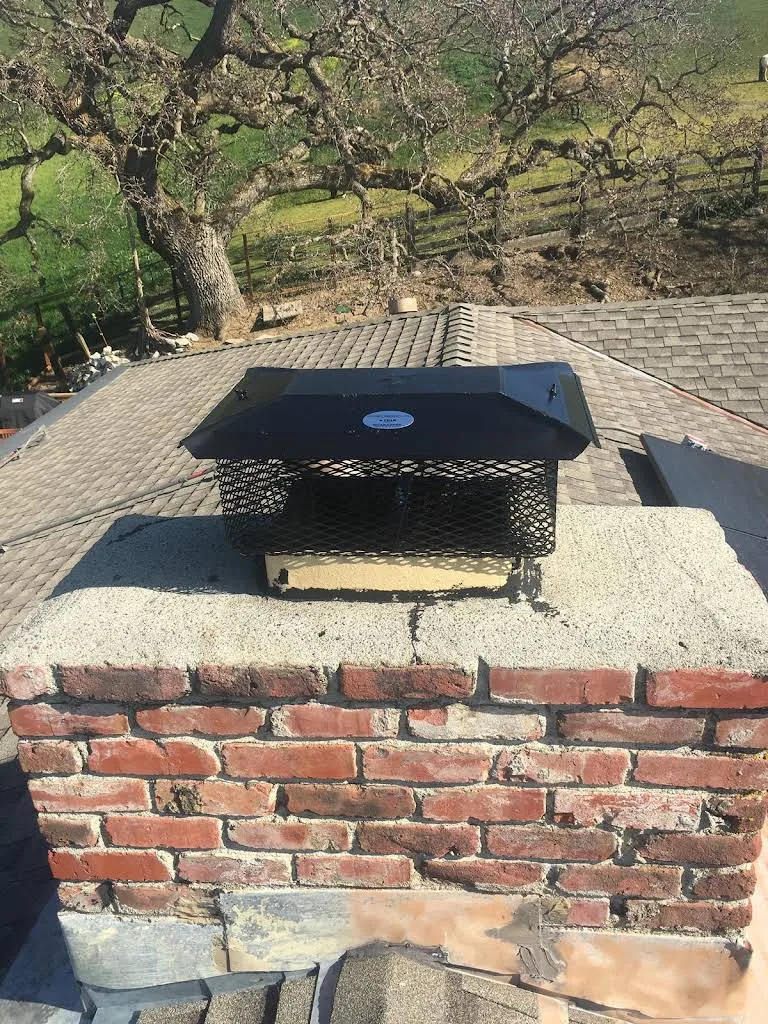
A chimney cap sits in wind, sun, rain, and airborne debris while preserving the venting path below. It looks simple from the ground, but fit depends on the flue, crown, appliance, number of openings, and attachment point.
Nation Wide Chimney Sweep & Repair’s owner-supplied project photos document cap measurement and replacement work in Sunnyvale. The visible variety is a useful reminder that caps are not universal hardware.
What a cap is designed to help with
A suitable rain cover helps reduce direct precipitation through the flue opening. Mesh screening can help limit leaves, twigs, nesting material, and some animal entry while allowing exhaust to leave.
The cap also takes weather exposure that would otherwise reach the opening directly. That does not make the rest of the chimney waterproof.
What a cap cannot repair
A new cap cannot seal failed mortar, rebuild a cracked crown, repair a liner, correct roof flashing, or solve every odor and draft problem. Water can enter through several pathways, and animal sounds can come from outside the flue.
If staining or leakage continues after rain, the full chimney top and roof intersection should be assessed rather than adding more sealant around the cap.
Measurements and system compatibility
The installer should identify the flue shape, dimensions, number of openings, material, crown condition, and attachment surface. Factory-built systems may require listed or manufacturer-specific components.
Clearance and screening must preserve the venting function. An improvised cover or mesh that is too restrictive can create a serious problem.
- Flue size and shape
- Single-flue or multi-flue arrangement
- Masonry or factory-built system
- Existing crown and attachment condition
- Visible corrosion, missing mesh, or wind damage
When to request a cap inspection
Schedule a review when the cap is visibly tilted, rusted, missing, noisy in wind, or surrounded by rust staining. Repeated leaves, animal activity, or water entering the firebox are also relevant clues.
From the ground, binoculars may reveal a missing cover, but rooftop measurements and attachment conditions should be handled with appropriate access and fall-safety planning.